If you’re self-employed or own a small business, this year’s significant health insurance changes will impact your costs, coverage, and access. The One Big Beautiful Bill Act (OBBBA) is reshaping the individual and small business health insurance market, driving up costs and pushing insurers out of the exchanges. This goes far beyond the end of ACA subsidies.
The choices you make as a business owner this November will directly affect your finances, and determine what care you and your team can actually access.
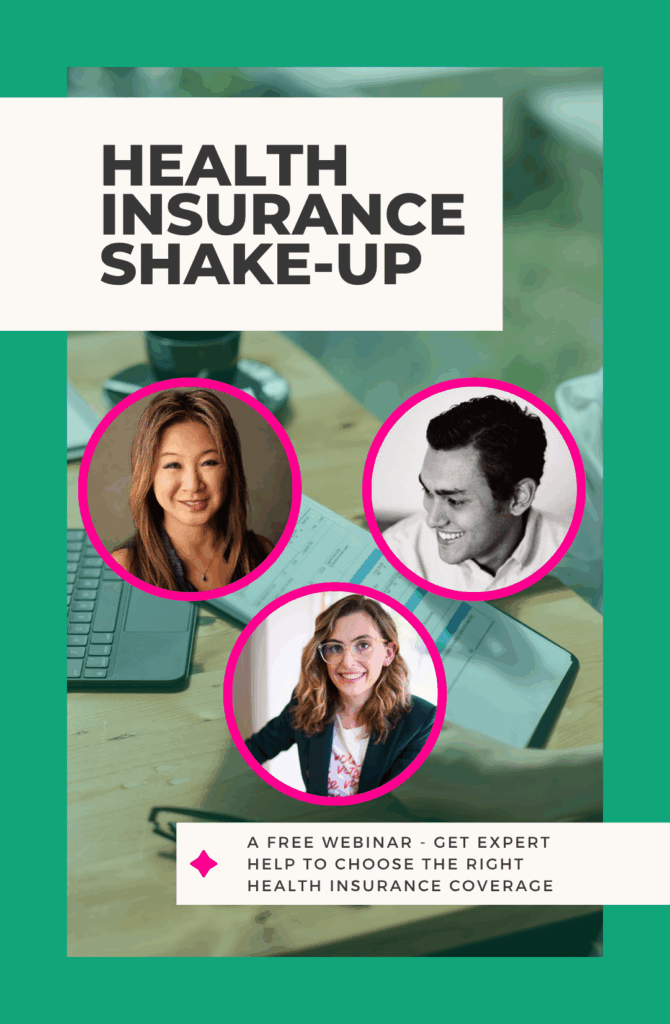
If you read this before October 28, TL;DR: Join our free live event on Tuesday, October 28 at 12 PM PT / 3 PM ET to review your options with benefits pros that specialize in self-employed and expected small business health insurance.
Evaluating your health insurance options can be overwhelming. If you’re new to owning a company or being self-employed, this might be the first time you’ve faced open enrollment without the guidance of an HR department.
In this article, we break down how to determine whether you qualify for an individual or corporate policy, and how to decide which coverage option works for you in 2026.
The Quick Take
Let’s start with an executive summary for 2026:
- Big 2026 Policy Shift: The One Big Beautiful Bill Act (OBBBA) ended extended ACA subsidies, increasing premiums and shrinking insurer participation in individual and small business markets.
- Coverage Requirements: Only a few states (CA, MA, NJ, RI, DC) still require individuals to have health insurance coverage. Small businesses with fewer than 50 full-time employees aren’t required to offer insurance but may do so voluntarily.
- Individual Options: Self-employed people can buy ACA- or MEC-compliant plans on Healthcare.gov, through ICHRA providers, or directly from insurers. Expect 12-30% higher costs and fewer choices on exchanges. In states without mandates, non-MEC plans are also available.
- Business Options: Small employers with at least one employee can provide benefits via QSEHRA/ICHRA reimbursements, group health plans, or PEOs that pool multiple companies for better rates.
- Timing & Planning: Individual open enrollment runs November 1–January 15, (enroll by December 15 for January 1 coverage). Employers should finalize and announce 2026 health benefits by early November and complete open enrollment by December 10 to avoid coverage gaps
Terms and Vocabulary
If you’re new to health insurance, start with our health insurance terms guide. We cover all the key terms you’ll encounter while shopping for and using your health insurance plans.
The Overall Market
Does the US have a public insurance option?
The US has two public insurance options for its citizens: Medicare (age 65+) and Medicaid (disabled, pregnant, or low-income). The OBBBA has impacted Medicaid eligibility in many states. Make sure you re-certify for 2026.
If you are self-employed and do not qualify for one of these plans, you will need to source your own insurance through a marketplace or direct provider.
Am I required to have insurance? Or offer it to others?
As an individual person, you must have health insurance that meets minimum essential coverage (MEC) in California, Massachusetts, New Jersey, Rhode Island, and the District of Columbia. If you do not maintain coverage, when you file your taxes, you will be assessed a penalty. (Vermont has an individual mandate but no penalty.) California, Maryland and DC have hardship exemptions for those over age 30.
If you live elsewhere, as an individual, you can skip coverage or buy a non-MEC plan based on your state’s insurance rules. That includes opting out of an employer’s plan.
As a small business owner, if you have fewer than 50 full-time US employees, you are not required to provide insurance under the Affordable Care Act. You may voluntarily offer health insurance or a cost reimbursement program as a competitive hiring benefit, or because you believe it’s the right thing to do.
If you choose to offer small business benefits, you will need to meet the requirements of the ACA: the plan must be MEC-compliant and you must pay at least 50% of the employee premium for the lowest-cost option.
Because small group plans get a multi-participant discount, you may find that sponsoring a corporate plan is more cost-effective than purchasing an individual policy.
How do I know if I qualify for an individual or corporate plan?
The minimum requirement for a small group corporate plan is you plus one employee who is not a family member or dependent. If you have just one employee, they must opt in to using your plan.
If your company only employs you, your dependents, or close family members, you will not qualify for a small group policy. You will need to purchase an exchange plan or direct coverage from an insurance company.
What plan types are available?
In selecting a plan, you’ll evaluate pricing structure and network access.
Pricing structure
All insurance plans charge a monthly premium. Your specific policy may have other direct payment requirements like co-pays, co-insurance, deductibles, and an annual out-of-pocket maximum.
In the ACA-compliant world, plan pricing structures are categorized as high-deductible (HDHP), Bronze, Silver, Gold, and Platinum.
High-deductible health plans appeal to the self-employed because they have the lowest monthly premiums. Consider these risk factors before choosing a high-deductible plan.
Bronze has the next lowest monthly premium cost but has high deductibles, co-pays, and out-of-pocket maximums. Silver and Gold have lower deductibles and co-pays.
This year, more plans qualify for health savings accounts (HSAs), including all Bronze plans and some HDHP Silver plans. Discuss these options with your HR, financial, or tax advisor.
Platinum is the most expensive option and has no deductibles or co-pays. Paying your Platinum premiums includes all use of covered medical care.
Note that some states have added Catastrophic plan options, available to those who have lost their premium subsidies. These plans are exempt from subsidies — you must pay the full premium to qualify.
Network Access
Network access refers to which providers, clinics, and hospital facilities will accept your insurance. You may see plans called limited network, EPO, HMO, or PPO.
Limited networks and EPOs are often local plans with a smaller list of providers or access to a single hospital system. Unless you go to an emergency room, your insurance will only cover services from in-network providers.
HMOs are closed networks of providers within a state or provider system. Services are limited to in-network providers from your home state. An HMO may be a closed system, like Kaiser Permanente, or an insurance plan that’s restricted to in-network providers only, unless it’s an emergency.
PPOs have the broadest options and include some coverage for out-of-network and out of state providers. (You will pay less if you choose in-network providers.) Small groups with employees in more than one state are required to use PPOs.
A note: I wrote “except emergencies” several times. Even on the most restricted network plan, or if you don’t have insurance, a law called EMTALA requires nearly all emergency medical facilities to provide you with care. While you’ll still be billed for services, your limited network or HMO insurance will provide some coverage for out-of-network emergency services.
Individual and Family Plans
As an individual, what are my options for coverage?
If you’re a freelancer, solopreneur, or solo LLC / S-corp owner with no full-time W-2 employees, and you don’t qualify for Medicaid, you will purchase insurance on the individual market.
Your options are:
- Buy a plan healthcare.gov or your state’s marketplace exchange
- Purchase through an ICHRA (solo / LLC only)
- Purchase a plan directly from an insurance company or through a health insurance broker
- Join a non-MEC plan (in states without individual mandate)
Here’s where I have to be the bearer of bad news. From January 1, 2026, the federal government is no longer offering enhanced insurance subsidies (premium tax credits). By passing the One Big Beautiful Bill Act (OBBBA), Congress ended ACA health insurance subsidies for almost 12 million Americans. At the time of writing, Congress was shut down and 48 Senate members were holding out for subsidies to be restored.
If subsidies are restored at 2025 levels, your credit will be based on your family size and adjusted gross income (AGI), which is the number left after all your business deductions and retirement savings are taken out. Subsidies are available up to 400% of the federal poverty line. For single people, that’s about $62,000. For a family of four, it’s $128,000. Out-of-pocket premium requirements have also been reset. Even if you receive a subsidy, you will be required to pay some amount monthly, up to 10% of your AGI.
If your AGI is under 400% of the federal poverty line, I would still explore your state exchange or healthcare.gov first, as that will include an evaluation of your family’s eligibility for your state’s Medicaid program, particularly for your kids.
Healthcare Exchanges
Even without extended subsidies, the ACA is still federal law. Insurers in each state can choose whether to offer plans on individual exchanges.
Exchanges are marketplaces of ACA-compliant medical, dental, and vision plans. Your base medical premium includes annual preventative exams like physicals and mammograms, pregnancy care, well-child exams plus dental and vision check-ups, and covered access to national emergency care. Providers cannot ask whether you have pre-existing conditions or differentiate premiums based on your gender. Cost is based solely on your age.
You’ll use Healthcare.gov or your state’s exchange. Before you start, you’ll need to know your expected 2026 adjusted gross income (AGI) and other income sources for your household. Your expected net income will be used to determine your eligibility for your state’s Medicaid plan.
Once you know your qualifying status, you will see your available plan options. Again, due to the OBBBA, the premiums you see may be significantly higher than previous years, and you may only have one or two available plan options in some states.
Compare coverage, providers, premiums, networks, and additional out-of-pocket cost levels to help you choose the right plan for you. These levels are mandated federally. 2026 out-of-pocket maximum for marketplace plans is $10,600 for an individual and $21,200 for a family of any size. Out-of-pocket maximums are in addition to your premiums. (However, if this amount is more than 7.5% of your AGI, you can deduct the excess on your 2026 tax return.)
Healthcare.gov’s 2026 open enrollment runs November 1 – January 15. To start new coverage on January 1, 2026, you’ll need to enroll, choose a plan, and make the first payment by 11:59 PM December 15. State-specific exchanges may have shorter or longer enrollment windows. Make sure you know your marketplace and deadlines.
ICHRA plans
If you are a single member LLC taxed as a C-corp, you may use an ICHRA to access a wider range of plans. This is an unlikely scenario, but if this applies to you, ICHRA provider Venteur has set up an ICHRA-specific instance of ChatGPT to help you evaluate your eligibility. ICHRAs include both marketplace plans and MEC-compliant plans offered directly by insurers. You may find a more affordable or appealing option in the off-market plans.
Non-MEC plans
In states without an individual mandate, you have the option to purchase plans that do not meet ACA requirements. These plans can be designed to include or exclude whatever they want, now or in the future. Things that may be excluded: pre-existing conditions, pregnancy, preventative care, or specific medications. Some have very high deductibles or only cover catastrophic emergency care.
If you are young or in generally good health and have no possibility of pregnancy or related complications, a non-MEC plan may be a more affordable option. Be sure to read the fine print and understand when you could be denied coverage. Plans may be offered by groups like fraternal orders, alumni associations, and religious organizations.
One of my trusted partners for non-MEC plans is Dr. Noor Ali, who offers concierge health insurance for individuals and very small groups. Learn more and book a free consultation with her team here.
Direct Market
Some EPO and HMO insurance providers will sell you insurance directly. For example, you can buy directly from Kaiser Permanente in states where it’s available. In states without an individual mandate, you may find direct non-MEC plan options. Visit the website of the specific insurance company you want to use. Look for “individual and family” coverage options.
You can also engage a health insurance broker who knows your local market and can help you access direct plans. Provide them with your preferred parameters and carriers. Brokers are paid by the insurance company; using one does not increase your premiums.
Remember, direct purchase plans may not be MEC- or ACA-compliant. If it matters to you, ask. If you’re not planning to get pregnant or are a cis man and don’t have pre-existing conditions, you can roll the dice and potentially save some money. Remember that direct plans are not subject to the out-of-pocket maximums mandated for marketplace plans.
How to pay
If you’re self-employed, your company can pay your health insurance premiums, including those for your spouse and kids up to age 26. Health care premiums are tax-deductible business expenses, paid on a pre-tax basis. Simply set up the recurring payment to be drawn from your business bank account.
Small Group Corporate Insurance
While you can initiate corporate coverage at any time during the year, most of us do it in January. If you want to start coverage for January 1, you’ll need to choose your approach by early November and complete your plan design no later than December 1.
If you want to offer some type of corporate health insurance, first, you’ll need to know if your business qualifies. Then, you can evaluate what coverage option is right for you. From there, you’ll set your policies and design your plan, and open it to your team for enrollment.
It’s important to communicate your intentions to your employees before November 1. If your team purchases their own insurance, they cannot get a refund for the first month’s premium.
Group Plan Design
Each year, you’ll have an opportunity to reset your health insurance plan and related policies, like who qualifies and how much you’ll pay.
Do I qualify?
The first question is whether you’ll qualify for a group policy. For medical insurance, you must have at least one full-time W-2 employee who is not a member of your family. (Some PEOs and plans have higher requirements, but one employee is the legal threshold.)
Corporate dental policies typically require at least three employee participants.
Can I make it affordable?
As a corporate plan sponsor, the ACA requires you to pay 50% or more of the employee’s premium for the lowest priced plan you offer. Two more considerations are participation and competitiveness.
Participation: If you don’t get enough employees to sign up, you won’t be able to take this plan for yourself, either. So consider whether two-thirds of your team needs coverage and you’ve priced it at a level they can afford.
ALE competitiveness: If you want to hire talent away from larger companies, you may want to pay more than 50%. ALEs must meet an affordability standard that does not exceed 9.96% of the lowest paid full-time employee’s gross pay. For 2026, the safe harbor value is $129.90 per month. Many ALEs also offer spousal and dependent subsidies.
Once you set your plan coverage amounts, they are locked for the year.
Is my remote team covered?
Do you have employees across the US? Most small group plans are designed for your home operating state, with everyone else “out of network” or “PPO network” for their care.
Ask your broker or carrier how employees outside your home state will access plans and medical providers. A strong provider in your home state – such as Kaiser in California or Oxford in New Jersey – may not exist in other places. Does the plan have a national network of providers? How will your remote employees access care? A PPO will be the most likely option. If you need a truly national plan, consider joining a PEO (more below).
How much direct HR support do I want to provide?
If you provide the insurance, your team will consider you, the owner and CEO, as the HR department and plan administration expert. Do you want to talk to them about their colonoscopies? About the co-pay for mental health or substance abuse counseling? About coverage for that out-of-state abortion? These are real questions I’ve gotten as the “HR department” for my clients.
If highly personal conversations are not your cup of tea, consider using a HRA, PEO, or an outsourced HR partner.
How do I make this a big win with my team?
If you’re new to offering corporate benefits, you can add them at any time of year. But please be respectful of the time, tax, and financial impacts on your employees. When you add benefits outside of an annual calendar cycle, you can really mess your team up financially by resetting their annual deductibles. Something that you expected to be a big win might turn into an angry all-hands pretty darn fast.
Also, please plan your offerings by November 1. If you will be offering any amount of healthcare support, clearly tell your employees by October 31. Many insurers will not return the first month’s premium, which could cost your employee thousands of dollars.
Now that I know I’m qualified, what are my options?
You have three ways to offer small business corporate benefits: Health Reimbursement Account (HRA), company-sponsored small group plan, or PEO.
QSEHRA / ICHRA
If plan design and underwriting feel like too much, or your employees have a variety of needs, using a Health Reimbursement Account (HRA) can be a great option. There are two types, QSEHRA (pronounced cue-SARA), for Qualified Small Employer Health Reimbursement Account (under 50 employees), and ICHRA (pronounced ICK-rah), for Individual Coverage Health Reimbursement Account.
Both are IRS-approved programs in which you reimburse your employees for plans and expenses of their choice, tax-free to both sides.
How it works: You choose an administrator and a reimbursement amount (both types) or a percentage of plan cost (ICHRA only) to cover. QSEHRA has a monthly maximum of $537.50 for individuals or $1,091.66 for families. (Maximums change annually in October.) You also choose whether the reimbursement is insurance only, or if it includes qualified healthcare expenses.
Your employees choose their own plans, usually within the provider’s available list, or provide proof of MEC-compliant insurance to the policy administrator. The administrator reviews eligible expenses and provides the monthly reimbursement amounts per employee. You never see any details of their healthcare choices, and you only pay for your team’s actual expenses.
Cost: You’ll pay a monthly administrative fee (typically $50-$100 per month) plus a small fee per enrolled employee. The administrator provides you and your employees the documentation needed annually to recognize these costs as pre-tax expenses.
As a sole proprietor or S-corp beneficial owner (owning over 2%), you cannot participate in a QSEHRA or ICHRA.
Venteur is our preferred ICHRA partner. They will facilitate employee payroll contributions and reimbursements directly with your payroll provider. Use their quote tool to evaluate your plan options and costs.
Company-sponsored group health plan
A group health plan is what you had at any job that offered health insurance. The company sponsors the plan, pays the monthly premiums, and collects money due from participating employees via payroll deductions. Group health plans are required to be minimally compliant (MEC) with ACA standards.
Corporate plans typically offer more services and broader provider networks, at a lower cost than the individual market. Many include mental health and alternative practitioners like acupuncturists and chiropractors. You may also be able to add coverage for fertility treatments.
Ways to Buy: You can purchase a small group plan through
- an exchange-based SHOP plan
- directly from an insurance company
- from a Multiple Employer Welfare Arrangement (MEWA), or
- via an insurance broker, which may be integrated with your payroll provider (like our preferred partner, Gusto)
How it works: You must pay at least 50% of the employee’s base premium, based on their age. At your discretion, you can pay up to 100% of the premium for your employees and their dependents.
For a MEWA plan, you may be required to pay association dues or join the sponsoring trade group.
Note, if you have fewer than 25 employees and meet average wage standards, you may qualify for a Small Business Healthcare Tax Credit, which was miraculously preserved in the OBBBA. All premiums paid are qualified business expenses and will be deductions to your taxable income.
If you qualify with one W-2 employee and that person leaves or is let go, you get to keep the corporate plan for the rest of the calendar year.
Professional Employer Organization (PEO)
If you’re open to a comprehensive HR solution, a PEO may be right for you. A PEO is an HR company that “co-employs” your employees, allowing it to combine small businesses for insurance buying power. Most offer national health plans from one or more major carriers like Aetna and Cigna, who don’t participate in the individual market. If you have at least five participants and want to offer multiple plans or compete with the Fortune 500, a PEO can be a strong option.
PEO packages may include perks like concierge medical, no-cost telemedicine, and coverage of fertility treatments. Please note that self-insured PEOs are NOT required to follow ACA-compliant underwriting. If you have a heavily female workforce of reproductive age, make sure you’re comparing PEOs.
How it works: A PEO acts as a “co-employer” of your team. To access PEO health insurance, you’ll need to sign up for their payroll and compliance services. You’ll be charged a monthly fee per employee, in addition to at least 50% of your employees’ base level health insurance premiums.
If you’d like to start your benefits on January 1 and you’re not yet on a PEO platform, you’ll need to commit by November 10. Most have a payroll onboarding process in addition to open enrollment.
Our preferred small business PEO is Rippling, which gives you control over your employees and policies, has 3rd party plan underwriting with Aetna and Cigna, and gives you the flexibility to keep a cash balance or profit sharing plan. Other PEOs to consider are JustWorks and Insperity.
In conclusion: why is this so hard?
Accessing health insurance is one of the most confusing, expensive, and high-stakes things you will do as an American small business owner. Until we separate health insurance access from employment (vote!), we’re here to help you align your benefits to your values, strategic growth plan, and budget.
Need more help? Sign up for my weekly newsletter, or schedule a complimentary 20-minute Strategy Session.