What's the difference between gross profit and net profit?
Gross profit is the money left after subtracting the direct costs of delivering your product or service from your revenue. Net profit is what remains after you also subtract operating expenses, taxes, and interest. Gross profit shows how efficiently you sell; net profit shows what the business actually keeps.
In recent issues, we’ve tackled a handful of intense, meaty topics:
That’s… a lot.
So, this week, we’re talking about a straightforward business fundamental that (hopefully) doesn’t hip-check you in front of an existential crisis bus about your business or life:
Gross profit vs. net profit.
It’s easy to feel badly about your business this time of year
My second year in business, I received an email from a consultant with a comparable business, crowing over her achievement of earning $800,000. I was crushed. But then I learned the real story — she spent over $1 million to generate that revenue, and hadn’t paid herself. Hmm.
When you hear people bragging about how much they “earned” last year, you might worry:
“Oh my gosh, they’re doing so well, and I’m not. What do they know that I don’t? What am I doing wrong? Am I a failure?”
Sure, they might have had a good year. (And since we’re good humans, we don’t root for others to fail just so we can feel better about ourselves.)
But when we tell the “success stories” of our businesses, we usually focus exclusively on the headline number: all the money that came in the door. Then we enthusiastically (and incorrectly) label that pile of cash “profit,” like we’re the Underpants Gnomes in South Park:
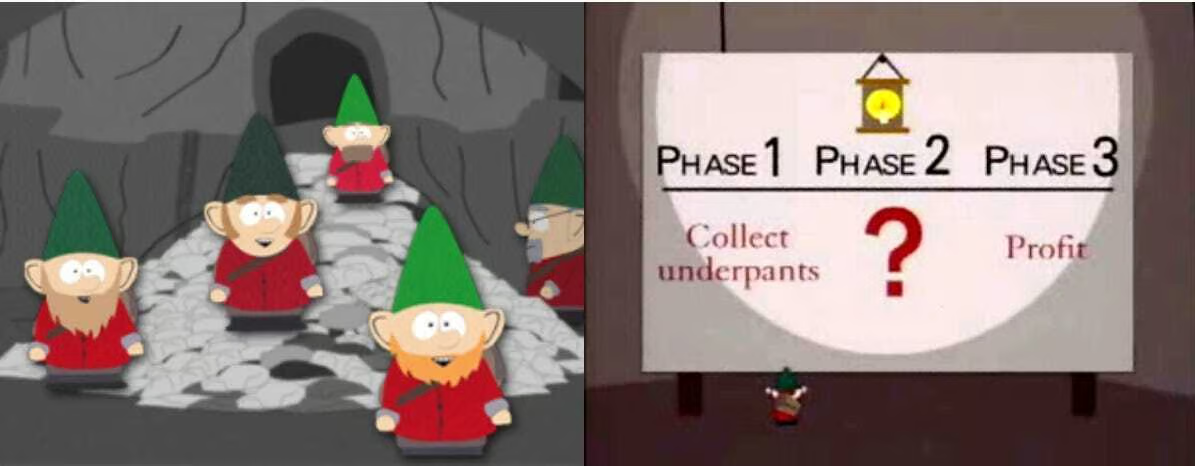
When you see those big numbers, it’s fair to ask — did you just collect underpants, or did you actually profit?
People take liberties with accounting words. “Earned” in accounting means income — the net amount after all the expenses are paid. Often, people use “earned” as a proxy for revenue, or the gross amount they collected. And there’s a bunch of other stuff we can’t know from a word like “earned.” Perhaps they piled up credit card debt, skipped health insurance, or didn’t pay themselves.
So where are the PR liberties, and what should you actually care about?
This is where knowing the difference between gross profit and net profit matters.
Gross profit is the unsung hero of your financial reports
Gross profit is the money you collected (revenue) minus the costs that it took to deliver that product or service.
For example, if you pay me $100 for a service, but I have to pay someone else $60 to successfully deliver that service, my gross profit would be $40. This is also called gross margin. My gross margin in this case would be 40%.
We also call this amount “above the line.”
If you run a product-based business, your above-the-line costs can take a pretty big chunk out of your revenue. Let’s say you charge $22 for one of those cute smooshy lights that the kids love right now. You pay your manufacturer $8 for that light, plus onshoring, customs and tariffs, and perhaps free shipping out to the buyer.
That $22 gets whittled down quickly.
Why does it matter? Knowing your gross profit determines how much money you have left to operate the business, cover any borrowing costs, and pay yourself. Every unit you sell contributes some amount to the rest of your expenses.
If you ask me, “Can I afford to spend X or Y?” my first look is to your gross profit. Does the investment help you sell more stuff, more efficiently? Or does the investment have to come out of the money left after we pay for everything else?
Net profit covers the rest of the equation
You have other stuff to pay for: software, licenses, rent, taxes, wages, and so on. These are the general administrative expenses that support the functions of your business, but do not specifically go toward delivering a product or service to a customer.
Your net profit is the number that remains after those are subtracted from your gross profit.
This is where we get real in your business.
For example, in December, I did a net profit test with each of my clients by running a test close. In one case, we initially had about 20% net profits. Amazing, right? But then we factored in the owner’s retirement savings, incentive compensation due to the team for generating those great profits, and some investments we’d need to make for 2026.
All of a sudden, 20% net shrank to 5%
Were we mad? Not at all. We made smart, timely investments.
Net profit is also what you pay taxes on — meaning this is the number we play with if we do or don’t want to have taxable income.
We want healthy gross profits. Frankly, in most cases, I don’t care that much about your net profit as long as we ended up there on purpose. I care that you make enough money from every sale to pay for the growth, operations, and compensation you want.
This is how you make smarter decisions
Early on, you’re probably more concerned about using your financial reports to get all of your tax deductions. Gross and net profit may not matter that much to you right now, because you threw a number out for your products or services to see what would work in the market.
And that’s OK! We all start somewhere.
As you grow, though, that collection of line items won’t tell you anything useful about how your business is functioning. Once you have to start paying for other people and real expenses, your gross and net will start to matter a lot.
So, go forth and use this knowledge well. Is it time to level up from just saving money on your taxes to knowing things that will help you run your business better?
Start-stop-keep: gross vs. net edition
OK, enough accounting talk. Here are your next steps:
START looking beyond your big pile of cash (revenue) at your gross and net profit numbers. Almost immediately, you will be able to make more informed choices about investments, compensation, and taxes.
STOP worrying about your business every time someone else brags about their flashy “earnings.” Good PR stories often don’t translate into healthy personal finances.
KEEP your compensation plans “above the line.” Focus on adding resources to help you grow, and paying people who help you achieve your goals.
Have more questions? Book a free 20-minute strategy session.